
Words by Maggie Arandela-Romano
There’s something oddly intimate about watching an actor watch themselves. The gesture is small — eyes narrowing at a scene, a half-smile flickering — but what’s reflected on the screen isn’t just the film. It’s time. Memory. Craft. The uneasy dance between how someone works and how they’re seen.
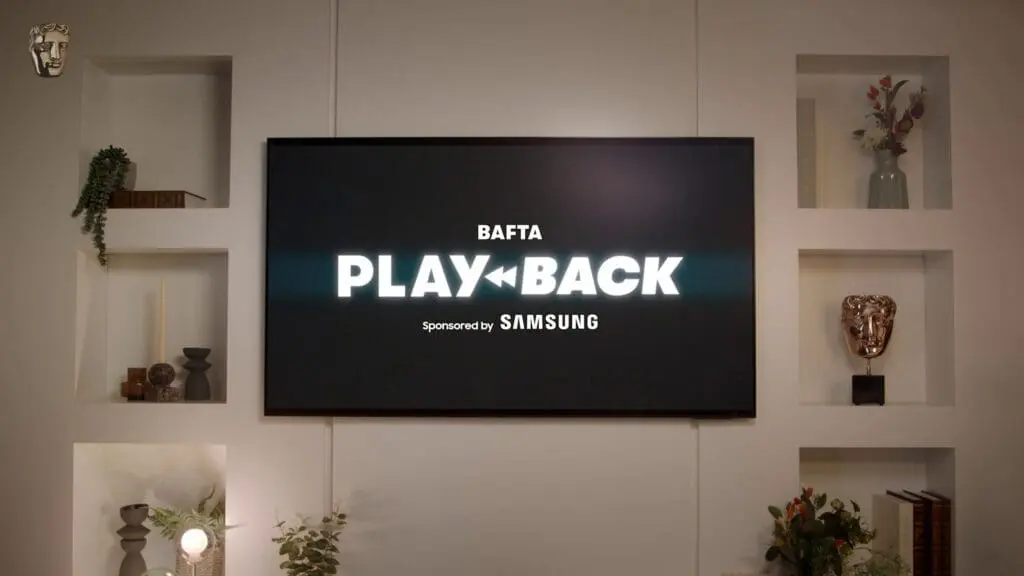
BAFTA Playback, the new six-part digital series launched by BAFTA in partnership with Samsung, leans into that intimacy. It strips back the machinery of awards and red carpets, placing six screen icons — Matthew McConaughey, Colin Farrell, Cynthia Erivo, Jennifer Lawrence, Jeremy Allen White, and Michael B. Jordan — in a lounge-style set, surrounded by objects that mark their careers. Each sat before a Samsung TV, watching scenes that defined their creative life.
The premise sounds simple. But there’s something richer at play. Watching these actors revisit their own mythologies turns into a quiet study of performance and perspective — what happens when the storyteller becomes the story’s audience.
McConaughey opens the series, fittingly. His career is a study in reinvention: rom-com darling turned existential drifter, moving between Hollywood gloss and dusty realism. On Playback, he traces the moments that shaped him — roles that bent, rather than broke, his screen persona. The camera lingers as he leans back, that familiar drawl softened by reflection. It’s not a confession, exactly. It’s an artist remembering what it felt like to become himself.
Each episode promises the same ritual. Farrell, whose recent work has blurred the line between bruised hero and absurdist philosopher; Erivo, whose voice carries a kind of defiance born of range and risk; Lawrence, still straddling the uneasy space between celebrity and credibility; Jordan, expanding from actor to auteur; and Jeremy Allen White, whose performance in The Bear turned the chaos of the kitchen into something spiritual.
They’re all at different points in their careers, but Playback gives them a shared stage: not a talk show, not an award interview, but a kind of cultural pause.
In an industry that moves faster each year, with success measured in algorithms and virality, Playback slows the clock. It returns to what BAFTA has long positioned itself as a guardian of — craft, storytelling, the inner mechanics of how great performances come to life. Yet the series also betrays a quiet awareness that even reflection has become a kind of content. We’re no longer satisfied with the film itself; we want the commentary, the context, the feeling of being inside the process.
BAFTA’s collaboration with Samsung isn’t incidental. The series, filmed on a bespoke set that resembles a hybrid of screening room and therapist’s office, is designed around the act of watching. The sponsor’s presence — Samsung as “Official Screen Partner” — adds a layer of irony: the technology framing the reflection becomes part of the story.
Zeena Hill, Samsung’s marketing director for TV/AV, calls the project a bridge between innovation and storytelling, where “the screen becomes the stage.” It’s a line that reads easily as corporate poetry, yet there’s truth there. The screen is the stage — both for the actors revisiting their past and for us, watching them watch.
We’re in an age where the idea of the screen has stretched beyond cinema or television. Phones, laptops, even public displays — every glowing rectangle is an invitation to perform. Playback understands that. It shows that the modern actor’s greatest role may be negotiating the self in an endless hall of mirrors.
In this sense, BAFTA’s series isn’t just about film heritage; it’s about digital culture. The line between “behind the scenes” and “the scene itself” has eroded. When Jennifer Lawrence laughs at an old performance, or when Erivo pauses before a moment that clearly still stings, the pause feels both spontaneous and staged. The honesty is real — but it’s also mediated, edited, lit.
That paradox — authenticity curated through production — defines the way we now consume art. We expect transparency, but we want it beautifully shot. Playback doesn’t hide that tension; it embodies it.
Emma Baehr of BAFTA describes the series as a chance to “celebrate outstanding storytelling” and to remind audiences of the craft behind the screen. BAFTA has long balanced reverence for tradition with the need to remain visible in a digital, globalised ecosystem. Playback fits that mission neatly — but it also gestures at a larger question: what does legacy look like in the streaming era?
For most of cinema’s history, legacy was linear — you built it, film by film, and the archive kept score. Now, the legacy is fragmented. Clips circulate in 20-second bursts on TikTok; film dialogue is repurposed as memes. The actor’s image has become modular, infinitely re-playable, endlessly interpreted.
In that landscape, Playback serves as both archive and antidote. It gives the performer agency over their own myth, letting them curate which scenes define them — or at least which ones they’re willing to claim. There’s something dignified in that.
It’s not nostalgia, exactly. It’s a reclamation. McConaughey’s murmured recollection of Dallas Buyers Club doesn’t romanticise the hardship of transformation; it considers what it cost. Farrell’s discussion of The Banshees of Inisherin isn’t about accolades; it’s about the quiet discomfort of being known for something so melancholic.
And in a subtle way, the series reminds us that fame is always a performance of continuity — the illusion that an actor’s choices form a coherent self, when in truth they’re fragments stitched together by viewers’ memories.
Culturally, Playback enters a long lineage of reflective media: Inside the Actors Studio, Desert Island Discs, even YouTube’s current wave of long-form interviews. What distinguishes BAFTA’s take is its atmosphere. There’s no audience, no interviewer interrupting. Just a quiet set, a screen, and the hum of remembered dialogue.
The absence of mediation makes space for sincerity — or at least the possibility of it. Watching Erivo describe her early stage work or White’s visceral reactions to early film roles carries the unguarded energy of artists processing their own evolution.
It’s a format that suits the age of fragmentation. The modern viewer no longer sits through full retrospectives; we scroll, dip in, sample. Playback’s six short episodes are built for that rhythm. But within that brevity, there’s still depth. Each clip feels like a miniature essay — on ambition, on self-doubt, on the fine line between character and self.
The partnership with Samsung inevitably raises the question of technology’s role in storytelling. Hill’s comment that Samsung’s mission is to make every story “experienced exactly as the creator intended” is both comforting and naive. Intent is a slippery thing. Stories shift with context. The same scene viewed on a phone in a noisy café, lands differently than in a darkened cinema.
Yet Playback uses that variability to its advantage. The screen, whether in a studio or a living room, becomes a confessional surface — a space where meaning flickers and refracts. Watching actors absorb their own work on a television screen reminds us how performance loops back into everyday life.
It’s also an image of how we, as viewers, use screens. We project, rewind, reframe. The device isn’t neutral; it mediates emotion. By letting technology sit so visibly within the aesthetic of Playback, BAFTA acknowledges that the screen has become part of the narrative language of self-reflection.
The numbers in BAFTA’s release — 350 million video views across platforms, 3.3 million followers, 2.5 million YouTube views monthly — reveal the scale of its digital presence. But more interesting than reach is resonance. Why does behind-the-scenes storytelling hold such appeal now?
Partly, it’s fatigue. In an era where performances are constant — on social media, in branding, in public discourse — audiences crave moments that feel unperformed. Watching someone as guardedly famous as Jennifer Lawrence lean into self-awareness scratches that itch.
It’s also about control. When stars narrate their own footage, they reclaim authorship in an industry that often fragments it. They become both subject and editor of their myth.
Still, there’s an undercurrent of melancholy in that loop. Playback suggests that even authenticity must be staged to be seen. The same camera that liberated actors to share their process also fixes them in high definition, forever performing their humanity.
There’s a calmness to Playback that feels almost radical. In an attention economy driven by speed, BAFTA’s choice to slow down and linger on process reads as defiance. The lounge-style set, the pauses between words, the texture of old clips — it’s a reminder that culture doesn’t only live in premieres and festivals. It lives in the act of looking back.
McConaughey’s episode sets the tone: the drawl, the deliberate phrasing, the way he makes even reflection sound cinematic. But beneath that polish lies something universal — the desire to make sense of one’s own story.
Each actor, in their way, uses the screen to locate themselves. Not as brands, but as people trying to understand what their work has meant — to audiences, to history, to themselves.
That’s what gives BAFTA Playback its quiet power. It isn’t just six actors reminiscing. It’s an exploration of how art becomes memory, and how memory becomes meaning.
There’s also a generational subtext here. Jeremy Allen White and Michael B. Jordan grew up in an era when the act of watching was already performative — think reaction videos, live streams, commentary culture. Their presence alongside industry veterans like McConaughey and Farrell creates an unspoken dialogue about the evolution of visibility.
For the older actors, reflection is about distance — what has changed, what endures. For the younger ones, it’s about navigation — how to stay visible without being consumed. That conversation plays out in glances and gestures more than words. It’s quiet, but it’s there.
And maybe that’s what makes Playback more than a polished digital series. It becomes a cultural artefact — a record of how we see our icons seeing themselves.
In the end, BAFTA Playback is both an archive and an experiment. It continues BAFTA’s mission to celebrate craft but also captures a wider shift in how we understand image and identity. The collaboration with Samsung underscores that art and technology now move in tandem, each shaping how we remember the other.
The actors may be watching their own performances, but the series also asks us to watch ours — how we view, react, and narrate our own moments in an increasingly mediated world.
It’s not nostalgia. It’s a reflection of survival.
And you, what is your “Have You Got Yours?”


