
Words by Alexander Seale
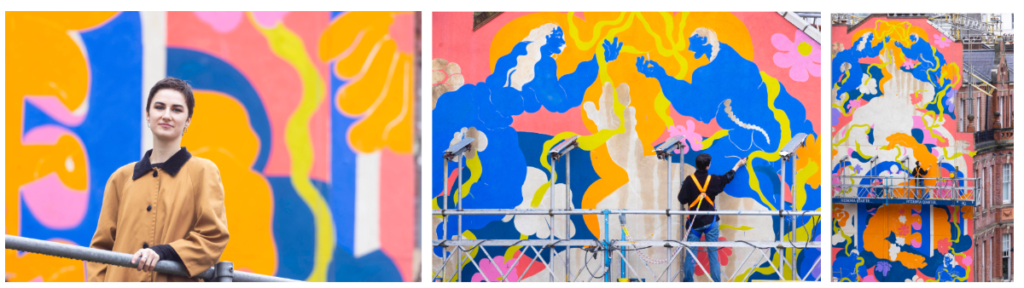
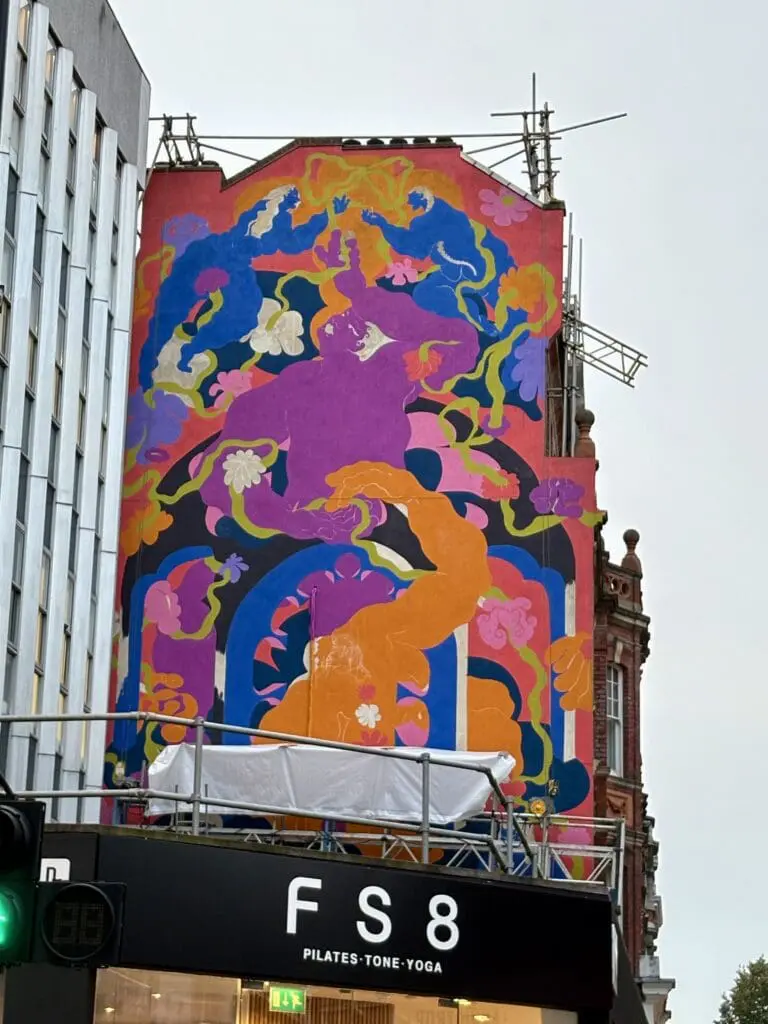
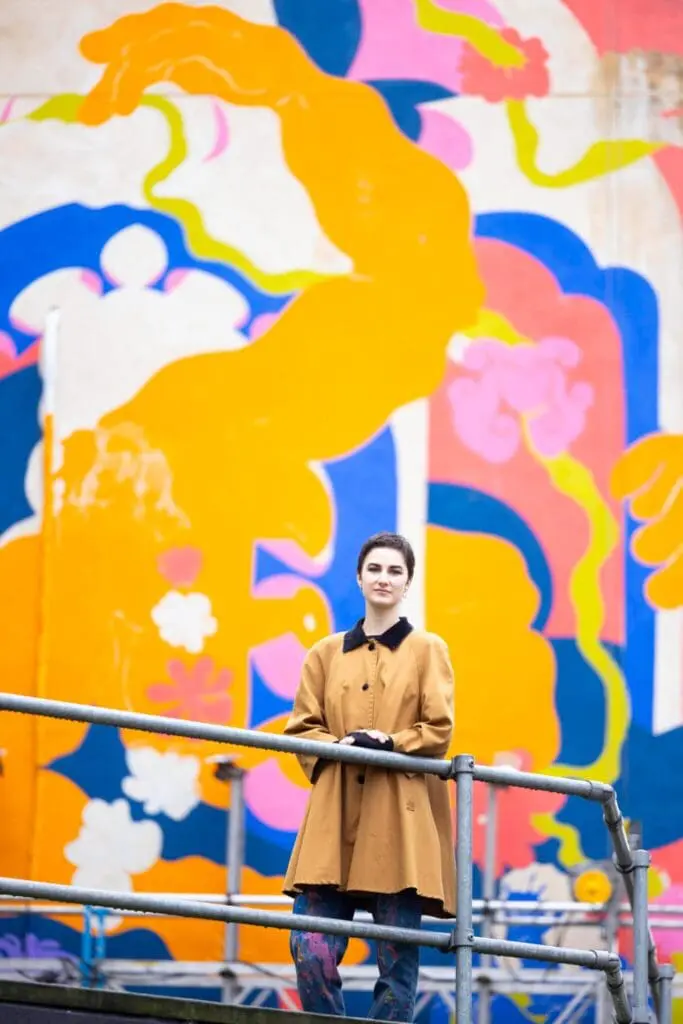
As autumn settles over London’s art season, Fitzrovia unveils a new landmark on Mortimer Street: Threads in Common, a 13.5-metre mural by Oliwia Bober, commissioned by The Langham Estate. The work marks the launch of The Artist’s Corner, a new cultural initiative from Fitzrovia Quarter, celebrating the area’s creative past and its evolving identity as one of the capital’s most dynamic artistic neighbourhoods.
Rendered in deep tones and intricate linework, Bober’s mural pays tribute to the women who once shaped Fitzrovia’s textile workshops — seamstresses, pattern cutters, embroiderers — whose quiet craft defined the district’s rhythm from the nineteenth to the early twentieth century.
“I wanted the mural to feel like a continuation of their work,” says Bober. “The patterns, the stitching, the repetition — they’re all gestures of care. It’s about recognising creativity not as spectacle, but as everyday life.”
To celebrate the unveiling, Fitzrovia Quarter will host a three-day pop-up exhibition — The Artist’s Corner — from 23–25 October at 55 Eastcastle Street, transforming an industrial space into a showcase of the neighbourhood’s creative community.
The exhibition brings together established and emerging artists in a collective display of Fitzrovia’s talent, from painting and photography to installation and design. Participating galleries include Pontone Gallery, Ab-Anbar Gallery, ST.ART Gallery, Eclectic Gallery, Des Bains, and Sisters Grimm, alongside cultural partners The Cartoon Museum, Fitzrovia Chapel, and The Newman Hotel.
Curated by Lydia Allain Chapman, the show invites visitors to experience Fitzrovia’s creative pulse firsthand.
“This exhibition brings together a community of emerging and established artists,” says Chapman. “Through figurative, abstract, and installation works, it explores how place and identity intersect — creating a dialogue between the gallery and the public realm.”
When I meet Bober at The Artist’s Corner, she’s painting directly onto one of the gallery’s walls — a looping design that frames the surrounding works in soft, figurative motifs. “It’s kind of a frame to go around the paintings,” she explains, stepping back to observe the shapes forming under her brush. “I like these kinds of characters holding hands and looking outwards — it feels like they’re part of the same story as the mural, just more playful.”
Her wall piece echoes the language of Threads in Common, carrying the same sense of connection and flow. “The idea behind both works is to look at different time periods in Fitzrovia — to combine the past and the present,” she says. “In the mural, the two central figures represent now, and around them are women from the garment trade who once worked here. It’s about meshing those two elements together.”
The pop-up exhibition surrounding Bober’s work features contributions from Taya De La Cruz, Melissa Hartley, Marie Louise Jones, and Bea Santos, spanning painting, resin, photography, and sculpture.
Highlights include:
Several artists in the show also draw from textile traditions and shared identity. “There’s this sense of connection running through everything,” Bober observes. “Whether it’s fabric, gesture, or storytelling — everyone’s exploring what ties people and places together.”
The exhibition and mural arrive in the wake of Frieze Week, offering a grounded counterpoint to London’s art-fair spectacle. Bober sees them as part of a different kind of dialogue. “Frieze is definitely a different crowd,” she says. “There’s so much beautiful art, but it’s less accessible. What’s nice about this project is that it’s free — anyone can come in. Art in public space has a different kind of intimacy. It belongs to everyone who walks past it. You don’t need an invitation — the street is the gallery.”
Local restaurants, hotels, and galleries are joining in with art-themed menus, cocktails, and events, extending The Artist’s Corner into the surrounding streets — an open invitation to explore Fitzrovia as a living cultural ecosystem.
Long before it became a postcode of media offices and design studios, Fitzrovia was a neighbourhood of makers. Its workshops supplied London’s West End; its boarding houses hosted artists and radicals. That creative energy still hums through its narrow streets.
Now, with Threads in Common, The Langham Estate and Fitzrovia Quarter have woven heritage into the city’s contemporary fabric. The result is both artwork and act of remembrance — a mural that turns a wall into a living archive.
As Bober finishes painting her figures on the gallery wall, she steps back and smiles. “I think of all these works as connected,” she says. “The mural, the drawings, this wall — they’re all about continuity. About how creativity links people together, across time. We’re all part of the same thread.”


