
Words by Eleni Leokadia
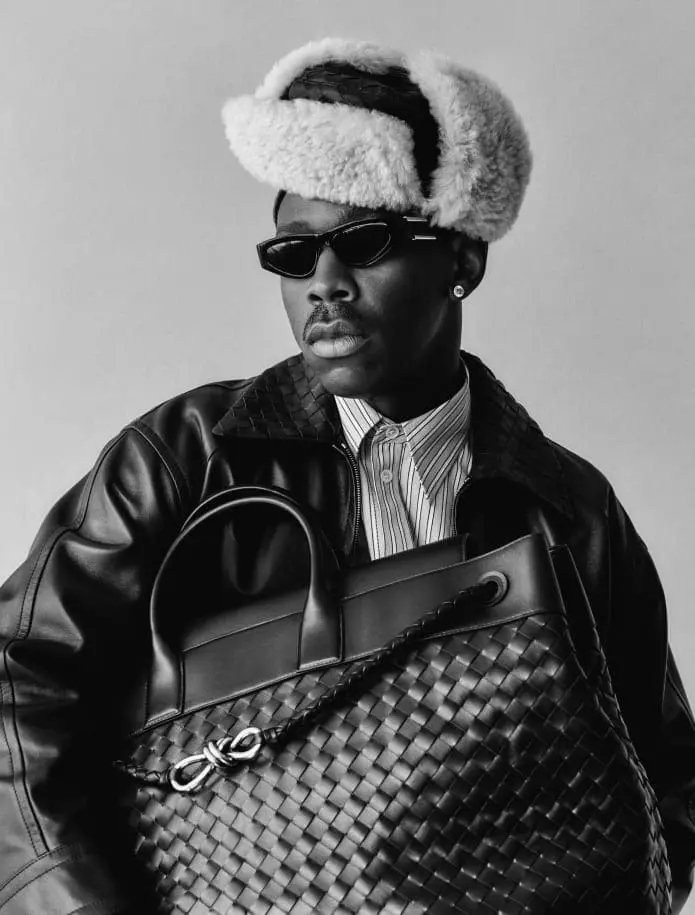
It’s been nearly two decades since Tyler, The Creator crash-landed into pop culture — loud, lo-fi, and skating the line between genius and chaos. Back then, it was Golf Wang graphics, OFWGKTA shock value, and lyrics wild enough to get him banned from the UK (yes, seriously — see Home Office, 2015).
Fast-forward to 2025: Tyler is now the face of Bottega Veneta’s latest campaign, Craft is Our Language. Shot in grainy black-and-white by Jack Davison and directed by Dave Free, the film marks 50 years of the intrecciato weave and acts as a teaser for what’s coming in September. There’s choreography by Lenio Kaklea and a cast stacked with cultural heavyweights: Zadie Smith, Julianne Moore, Neneh Cherry, Shu Qi, Barbara Chase-Riboud.
But the clothes — sculpted tailoring, soft knits, and woven leather — are hardly the focus. Instead, the camera lingers on hands. Hands reaching, folding, working.
One could argue it’s a heavy-handed double entendre — pun intended — a visual nod to weaving and a conceptual echo of intention; after all, hands are the universal symbol of making. The campaign references Bruno Munari’s 1963 book on Italian hand gestures — a wink to bodily language as a mirror of design.
However here’s the thing: even when the hands belong to legends, they’re rendered anonymous when removed from their owner. By zooming in, the camera detaches them from fame. The message? Craft speaks louder than brand. Or rather: the work matters more than the name. An obvious nod to Bottega’s philosophy — after all, their slogan for the past 50 years has been: when your own initials are enough.
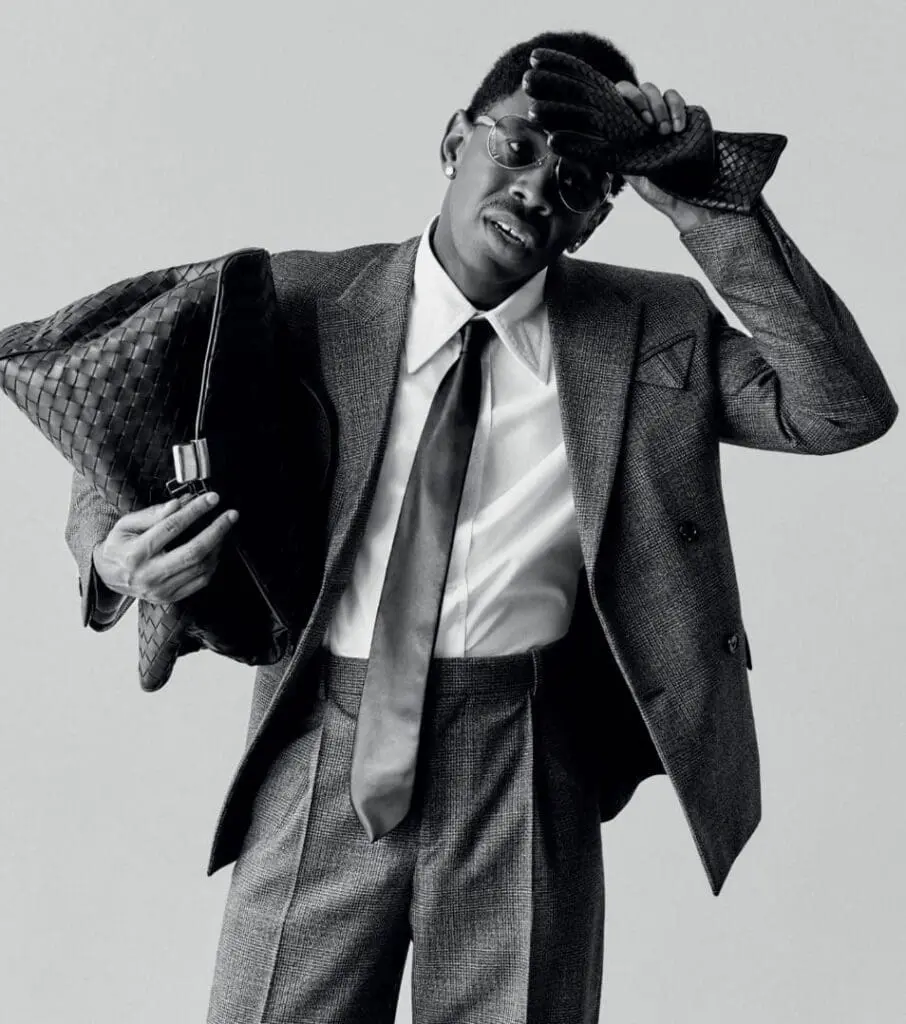
This also makes the casting of Tyler — one of the most audibly not-quiet artists of the last 20 years — ironically perfect. This is the same Tyler who once rapped about centaurs, lewd cartoons, and eating roaches. Who engineered his own loudness as cultural disruption. Who made noise the point.
So why does it work?
Because beneath the chaos, Tyler’s always been obsessive about craft. Every album isn’t just a project — it’s an era, a character, a world with its own aesthetic rules and emotional arc. The grayscale angst of Bastard, the chaotic adolescence of Goblin, the candy-coated vulnerability of Flower Boy, the lovesick glam of IGOR, the Euro-chic bravado of Call Me If You Get Lost — each one is fully costumed, colour-coded, and moodboarded. And yet, they all echo one another. Each era leaves breadcrumbs for the next: a lyric here, a visual motif there — like an insider club for fans fluent in his language.
Even the chaos is curated. Just like Bottega’s silence is never passive, Tyler’s loudness was never messy. Both are stylized forms of control.
That shared control is where Louise Trotter steps in.
As one of the few female creative directors at a major fashion house, Trotter carries the weight of heightened expectations and scrutiny. Since stepping into the role in late 2024, she has navigated the delicate balance of preserving Bottega’s mystique while keeping it visible. It’s like running an exclusive club everyone knows about but few can enter. Daniel Lee tried to maintain that mystery too, but even he couldn’t sustain Bottega’s social media blackout beyond a year. With attention spans barely lasting past a reel — and sensory overload coming from wild fashion moments (a giant red rubber boot, a pigeon-shaped bag) — Bottega’s “if you know, you know” attitude risks fading into the scroll.
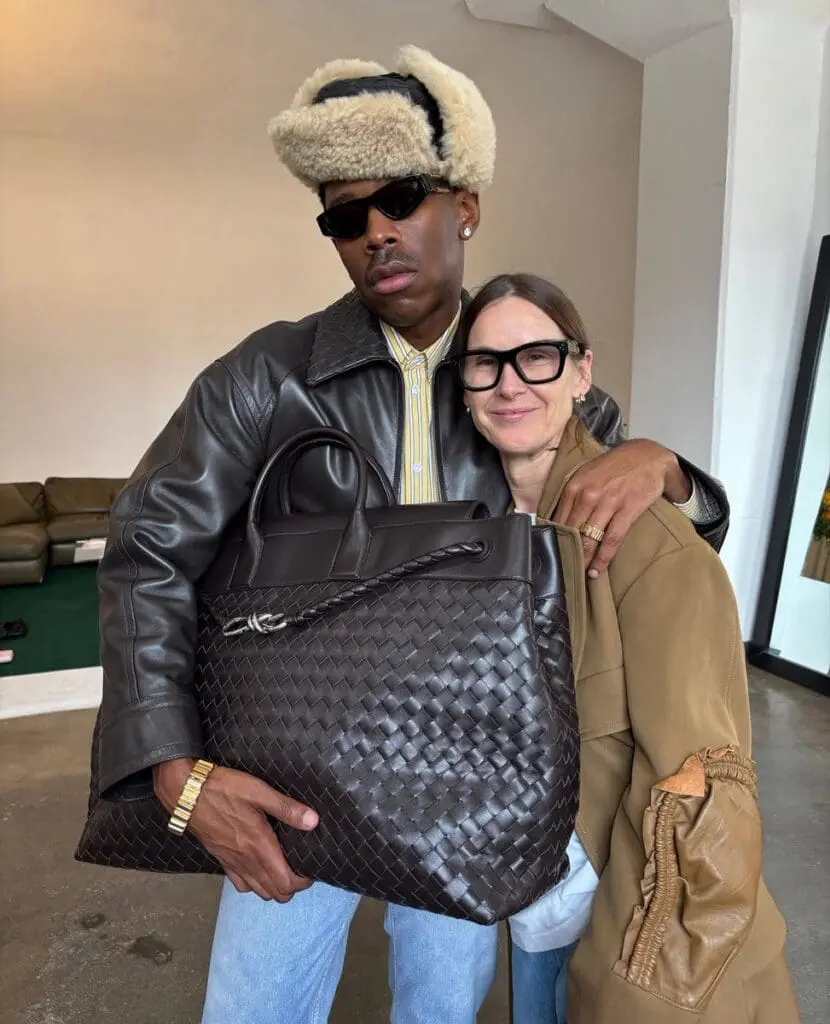
This is where Tyler comes in — a bold, clever choice. Eye-catching, loud, and occasionally controversial, he remains a master of his craft. Just as Bottega shapes leather, Tyler shapes culture — distinct yet resonant forces on opposite ends of the spectrum. Paired with Dave Free’s layered visual style (think Kendrick Lamar’s “HUMBLE.”), the campaign transcends mood to become structure: a quiet, powerful assertion of philosophy that proves Trotter knows exactly what she’s doing.
By choosing Tyler, we see Trotter quietly continue Matthieu Blazy’s assertion of legacy and quality, embracing tradition while ramping up Bottega’s online presence. Instead of deleting Bottega’s media presence altogether (as Lee did — ironically, while producing some of the brand’s flashiest campaigns), she’s redefining it. Aligning the brand’s image with the quality of its leather — and the calibre of its people. This campaign stakes her claim in Bottega, upholding tradition and brand integrity while generating serious buzz and staying relevant.
Still, you have to wonder — does this nuance actually land? Will most see more than “cool celeb, cool filter”? Maybe not. But that’s the point. Trotter and Free aren’t courting the algorithm. They’re refusing it.
They’re courting only those who look long enough, maintaining their audience through subtlety. Bottega’s quiet confidence demands patience — an invitation to look beyond the surface and recognize craftsmanship as a language of its own.
In this way, nuance refines the customer, preserving their quiet luxury club. They’ve stripped away the flash and the attention-seeking: no influencers, no product placement — just thinkers, artists, polymaths. People who make more than they perform. In a landscape saturated with campaigns chasing virality, Bottega’s restraint feels radical.
Perhaps in the future, we’ll see the hands behind the scenes — the artisans, leatherworkers, and bag makers whose expertise has quietly defined Bottega for five decades. After all, what’s the point of celebrating handmade craftsmanship if you don’t honour the hands that bring it to life?
Craft is craft — whether shaping leather or shaping culture, like Tyler.
Where does it go next? We’ll see in September. But one thing is clear: Tyler doesn’t need to shout anymore. Bottega never did.
Together, they remind us: noise fades. Craft doesn’t.


