
Words by Lola Carron

In The White Lotus, fashion doesn’t decorate the story, it tells it. It reveals character, creates context, and communicates what the script doesn’t say out loud. In Season 3, set against the sun-washed softness of Thailand, every outfit is a clue. The styling speaks to power, privilege, transformation, and control — the show’s central themes — without a single word. Costume designer Alex Bovaird has always understood this, but in Season 3, she leans in fully. The clothes aren’t just beautiful. They carry the narrative.

Piper Ratliff enters the season mid–existential pivot, announcing she’s renouncing her privileged lifestyle to spend a year in Thailand studying Buddhism. She arrives in crisp linen and designer sandals, waxing poetic about detachment and simplicity — but by the end of the night, she’s crying over the resort running out of La Mer. Her ‘spiritual awakening’ lasts less than 24 hours. The brilliance of her styling is in how it reveals this contradiction without a word: every “pared back” look is still head-to-toe luxury, curated to appear effortless but costing thousands. She’s ashamed of how much she needs the comforts of her world, but even her embarrassment is steeped in privilege. The show doesn’t just critique her tone-deafness — it exposes the performance of stripping down, when the safety net of wealth is still waiting beneath the robe.
If Piper is trying to dress her way into softness, Chloe’s wardrobe performs a different kind of control — one rooted in mystery, not reinvention. Played by Charlotte Le Bon, cool, observant, and unsettlingly composed, Chloe has the kind of rich-girl minimalism that looks effortless but is clearly anything but. Her episode four look has already become iconic. Draped in a custom Jacquemus baby pink swimsuit, sheer wrap, and structured sunhat, she manages to appear ethereal and calculating all at once. The outfit is soft, but never passive. It says, “You can look, but you won’t know me.”

What makes Chloe’s styling so effective is its subtle manipulation of silhouette and palette. The colour choices are romantic, but the lines are sharp. Nothing clings too tightly. Nothing looks uncomfortable. It is a curated performance of ease — fashion as silent dominance.
Where Chloe conceals, Chelsea reveals. Her looks are chaotic, experimental, and emotionally honest — a wardrobe that doesn’t apologise. Chelsea is played by Aimee Lou Wood, whose slightly mismatched, occasionally unflattering outfits are completely captivating. She dresses like she’s trying things on emotionally and stylistically. Pattern clashing, offbeat layering, accessories that feel just a little too considered. Chelsea’s clothes aren’t aspirational in the traditional sense, but they’re some of the most honest in the series. She is someone learning how to present herself, and the process is messy, vulnerable, and refreshingly real.

If Chelsea dresses for feeling, Victoria dresses for power. Her style is high-control, high-status — the aesthetic of someone used to being seen but rarely challenged. Victoria is the matriarch of the Southern family dynasty and might just be the most watchable woman on screen this season. She arrives in crisp collars, ladylike prints and matching sets that look sweet on the surface, but are styled with such precision, they become quietly intimidating. Her looks are crisp, ultra-controlled, and perfectly packed. She dresses like a woman who refuses to unravel, even when everything around her is coming apart. Her high-neck blouses and cinched silhouettes feel almost suffocating — styled to reflect a woman gripping onto elegance as a shield.

And then there’s the girls’ trip trio, who offer some of the season’s most layered fashion dynamics. Each of them dresses like they’ve known each other forever, but no longer align in the same way. Their wardrobes are polished, curated, and trying very hard to say “just another holiday,” even when the energy is off.
Laurie, a New York corporate lawyer and newly divorced mum, dresses like she’s holding everything together with a bold lip and a structured handbag. Her style is guarded in a different way, leaning into masculine tailoring and low-effort accessories, like someone trying not to take up too much space. Her outfits are colourful, glossy, and always fully assembled — bright prints, fitted dresses, coordinating accessories. But the effect is almost too much. Laurie is styled like someone constantly trying to prove she’s fine. Fashion becomes her defence mechanism — a high-shine distraction from emotional instability.
We also meet Jaclyn, played by Lesley Manville, who leans fully into the ageing party girl aesthetic. She wears mini dresses, sheer kaftans, and plunging necklines with the confidence of someone who refuses to fade into the background. Her outfits are loud, skin-baring, and just slightly off for the setting. She’s not badly dressed — she’s fighting against invisibility.
Together, they embody three different versions of femininity in flux — all trying to dress their way into control. Whether it’s Kate’s tight composure, Laurie’s high-functioning perfectionism, or Jaclyn’s full-throttle refusal to be written off, their clothes speak clearly even when they don’t.
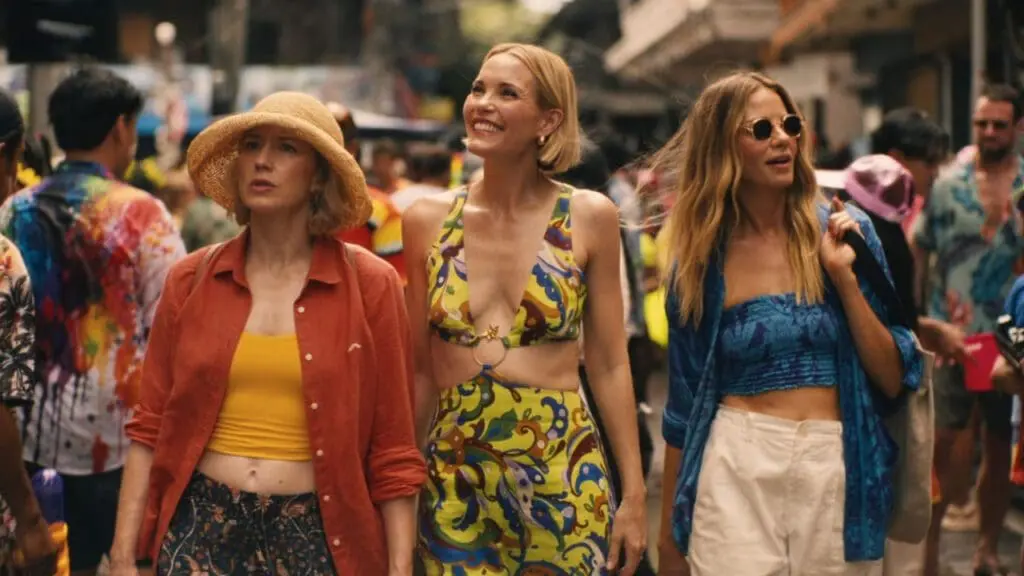
This is fashion that doesn’t try too hard to be fashionable. No logos, no look-at-me moments, but a deeper sense of self-styling that says everything about status, insecurity, and survival. It’s a different kind of power dressing — one that doesn’t demand attention, but takes it anyway.
This narrative approach to fashion mirrors a broader cultural shift we’re seeing beyond the screen — a move away from overt trend-chasing and toward dressing as a quiet expression. It’s not just about logos or aesthetics anymore, but about clothes that reflect intention, vulnerability, or control — without needing to explain themselves.
We don’t watch The White Lotus for the murder mystery. We watch it because it shows us what people do when they think no one is watching — and what they wear when they know everyone is. It’s the clothes that carry the plot. They tell us who’s pretending, who’s spiralling, who’s winning, and who’s about to lose it all — long before the dialogue catches up. Season 3 gave us fashion that lingered. That whispered instead of screamed. That told the truth even when the characters didn’t.
And as viewers, that’s what we’re really watching for.
Not death. Not the drama.
The outfits. They’re the ones telling the truth.


