
Words by Isabelle Knevett
Edited by Valerie Aitova
They say a picture is worth a thousand words but the quiet, intricate craft of costume design can speak volumes more. Nowhere is this truer than in the recent fervour surrounding Guillermo del Toro’s vision of the iconic gothic horror novel by the queen of the macabre herself, Mary Shelley. His adaptation unfolds as a cinematic worldscape; a story of monsters and men, of life and death, ego and the fragile human desire to love. Whatever your view on how faithfully del Toro interprets the novel, the couturial care poured into the film’s costuming is undeniable. Award-winning designer Kate Hawley dresses each character with a precision that shapes the emotional texture behind every scene.
The New Zealand designer is far from a newcomer. Neither is this her first collaboration with del Toro, having worked alongside the director for Pacific Rim, Crimson Peak and the never-produced Hobbit trilogy before now. Yet it is her work on Frankenstein that has truly captured the imagination of the sartorial set.
Channeling the rich gothic world crafted by del Toro, Hawley’s designs become an essential extension of the film’s visual language. She creates a tableau that is at once whimsical and devastating, weaving costume into story with a feeling that lingers.

A stark introduction into Victor’s childhood, Hawley reported that the colour scheme for this era of the character’s life was scarlet red, black and white. The red is a recurring theme throughout, perhaps representing the returning curse of death in Victor’s life or even nodding to the ongoing motif of motherhood, birth and creation. Hawley credits the colour white with representing death in the early snow scenes; combined with black and red, it creates a striking and consistent palette.
From the very first glimpse of Victor Frankenstein’s mother (Mia Goth in the first of her dual roles) we are met with a haunting vision in scarlet. A sheer, foreboding veil obscures her face and conceals a modern, almost 60s-esque black-and-white chevron gown that sweeps up the steps of the historic house behind her. The crimson hue hints at her early death and we see it return later in Victor’s own harsh red leather gloves, a mirror of the both perceived and real blood on his hands since childhood. In an interview with British Vogue, Hawley revealed that much of Victor’s costuming draws from 70s rock icons, and the influence is unmistakable. In the red velvet coat, the razor-sharp tailoring and the flowing green dressing gown worn over a bare chest and pyjama trousers, an aesthetic only Victor, Jagger or Bowie could carry with such confidence.
For the Creature, born naked and stitched from many bodies, clothing becomes a symbol of identity. First seen almost entirely bare save for a few bandages, he sheds them to reveal himself to his maker. Once free in the world, he scavenges piece by piece, beginning with Crimean war garments taken from a soldier’s corpse. By the film’s end he is a patchwork of disintegrating fabrics and disparate styles, assembled with the same unsettling logic as his own self.
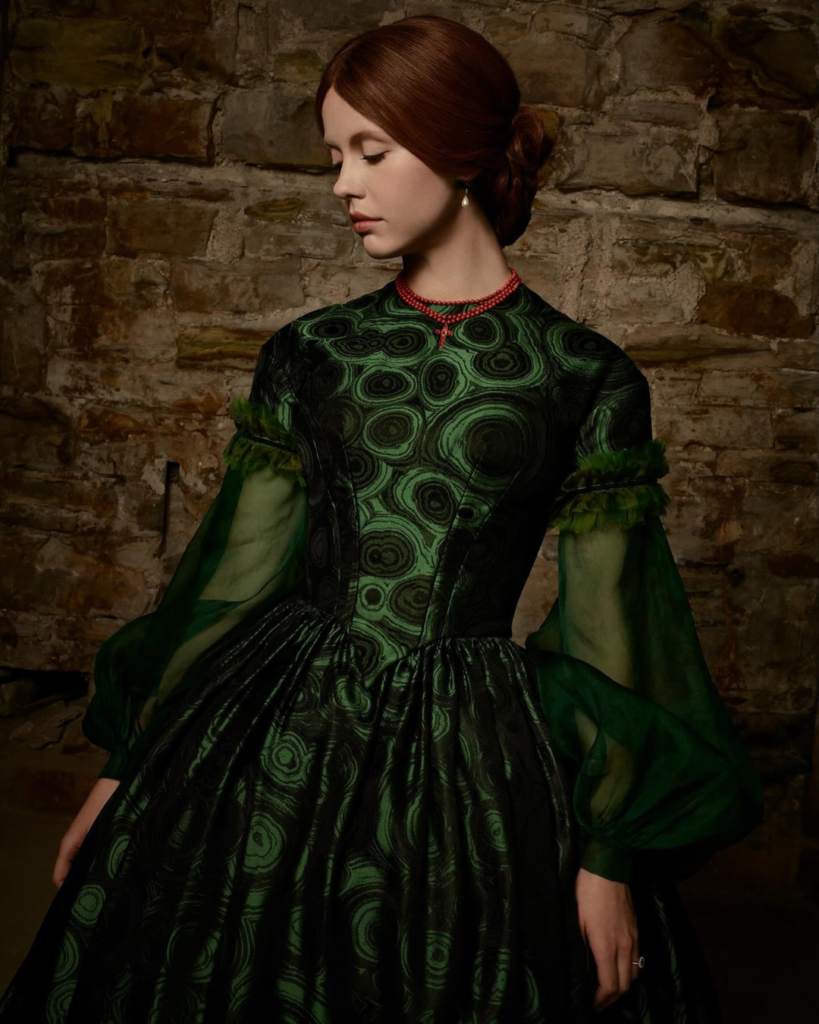
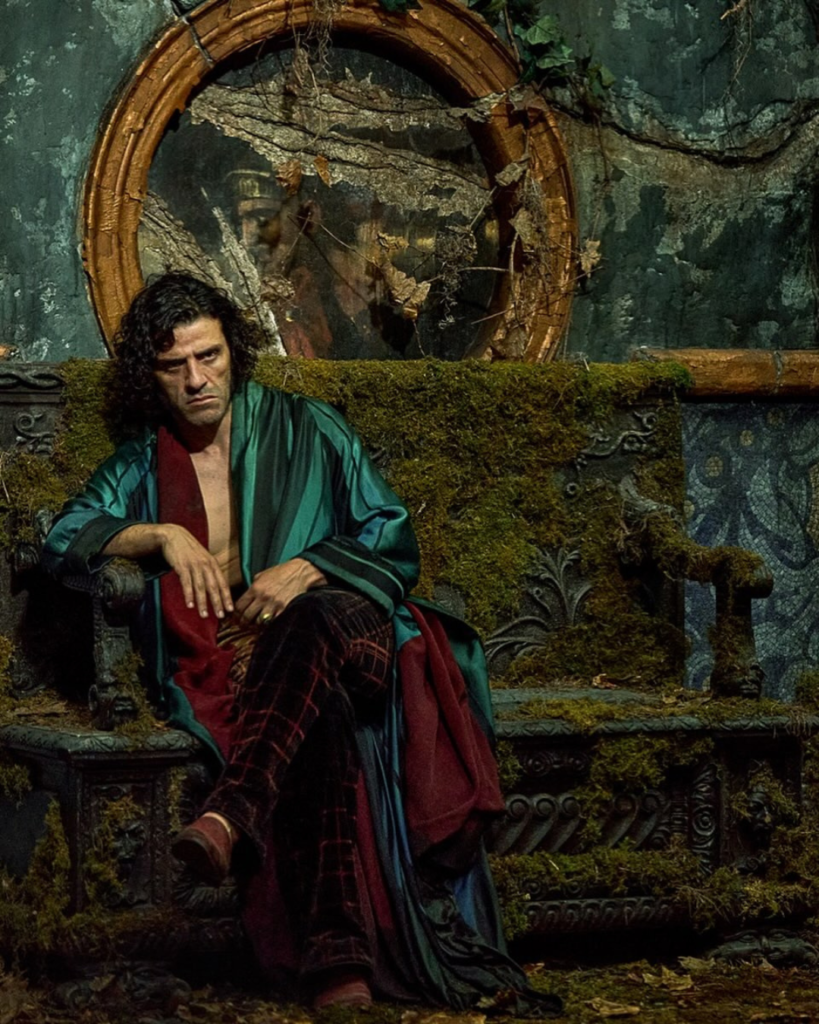
Mimicking the look of the stone Malachite, Elizabeth’s clothing is a direct reflection on her commitment to the natural world. Juxtaposing Victor’s pursuit of the unnatural and otherworldly.
Taking style cues from the rock and roll stars of the 70s, Victor’s flowing silk robes and devil may care aesthetic feels worlds away from Victorian England, yet sets the scene for the character’s development.
Yet it is the costuming of Elizabeth Lavenza, again portrayed by Mia Goth, that has captured the couturial imagination. With each look, Hawley builds a universe around Elizabeth, who acts as both Victor’s emotional anchor throughout the story and so the visual centre point throughout the film. Our first encounter shows her in a striking blue gown based on the silhouette of an X-ray, her head crowned with a downturned feathered halo. Circular motifs appear repeatedly in her hats and bonnets, echoing the halos found in religious art.
Much of Elizabeth’s wardrobe draws from the natural and the cosmic. The beetle necklace she wears with the blue gown is not only a rare archival Tiffany & Co. piece but the beetles are scarabs; symbols of regeneration and rebirth. Her iconic red cross that she wears throughout, centred with another scarab, reflects her alignment with a natural theology. Later, she wears a vivid green gown patterned to resemble malachite – a stone associated with both protection and transformation but also the absorption of negative energy, hinting that her fate may have been sealed long before. Another gown, in a softer more muted green, mimics the cellular forms from her anatomy textbooks. Elizabeth shows throughout the film her dedication to the natural world around her, she is fascinated by insects and bugs, presenting Victor with a butterfly, spending her days dissecting books on the topic. She mirrors Victor’s obsession with the unnatural desire to bring life back.
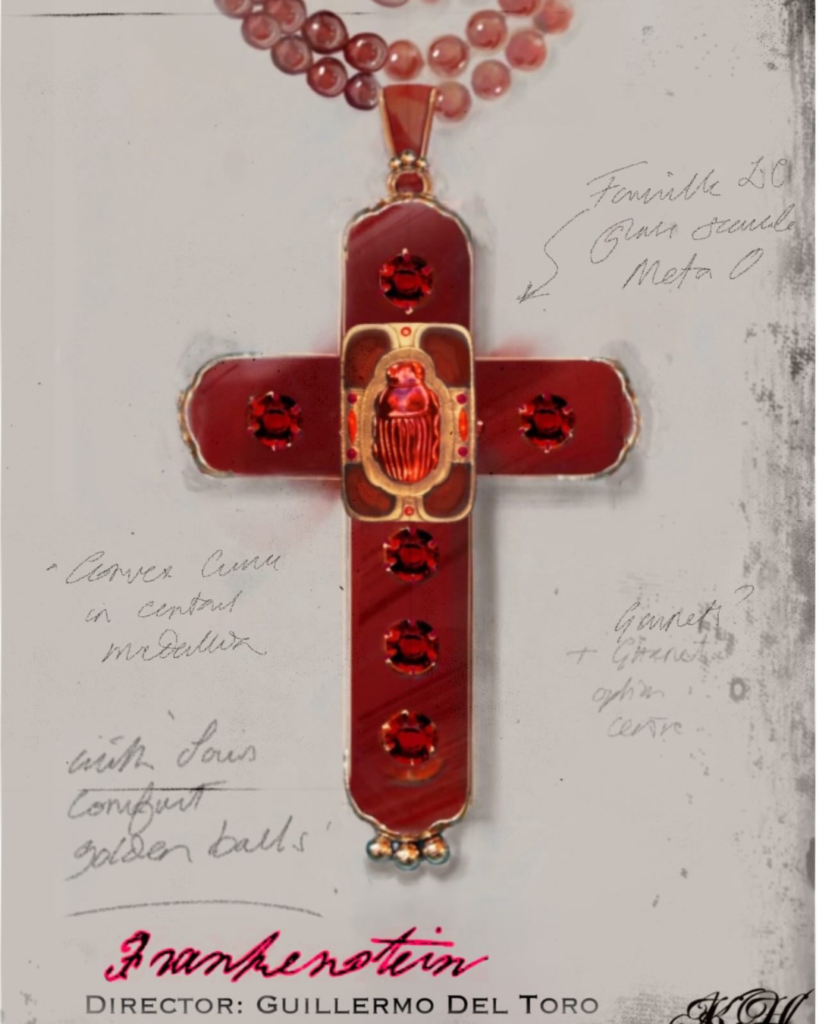

But it is Elizabeth’s final ensemble that resonates most deeply with the film’s themes. As she awaits her marriage, the Creature discovers her in an exquisite white wedding dress. Its ribboned sleeves echo both his own early wrappings and the iconic imagery of The Bride of Frankenstein (perhaps a deliberate tease of what is yet to come). Her red cross rests once more at her throat. Hawley notes to W Magazine that the gown is constructed from three layers, much like an X-ray, and in the final moment between Elizabeth and her beloved Creature, scarlet blood seeps through the organza – a visceral tableau that binds costume to the narrative with startling precision.
In Frankenstein, Hawley’s work does far more than clothe its characters, it’s a vital organ of the film itself. Her work has led her to be nominated for the first-ever Costume Designer of the Year award from the British Fashion Council in late 2025, alongside other modern cult classics like the Wicked series and Nosferatu. The public’s obsession with the weird and wonderful in fashion, film and culture is only set to grow, acting as a world-building escape away from the stressful and strenuous reality. Every decision in every costume contributes to del Toro’s gothic vision, weaving history with modernity, romance with ruin. It is costume design that has captured the hearts and minds of those lucky enough to see it, and proves the eternal art that is fashion has its place upon the silver screen.


